
Powering AI processors – 48V vertical power delivery changes the game
AI models demand huge current, driving legacy multiphase designs past 50 phases—causing space, thermal, and control limits Vicor addresses


ケーススタディ: 5G indoor small-cell base station

The demand for mobile data, video and music streaming has increased wireless network demand exponentially, and 5G networks are expected to provide the necessary increased network capacity. The higher bandwidth required of 5G connections limits the range of base stations, necessitating a higher density of antennas, especially in buildings where radio signals have limited penetration. The key goals for this indoor base station were:
Size and weight objectives were met by using BCM bus converter modules and ZVS Buck regulators, both utilizing high switching frequencies for a very power dense solution. Further space savings were achieved as Vicor’s proprietary Sine-Amplitude Converter topology increased efficiency, reducing cooling requirements even at high ambient temperatures. Key benefits were:

Reduced footprint of just 6.4cm2 and profile of <7mm enabled by high- density converters

Operation at high ambient temperatures requires little cooling due to high efficiency topologies (>94%)

Scaling to meet future requirements straightforward as converters are easily paralleled
Vicor power modules provide high power density and high efficiency
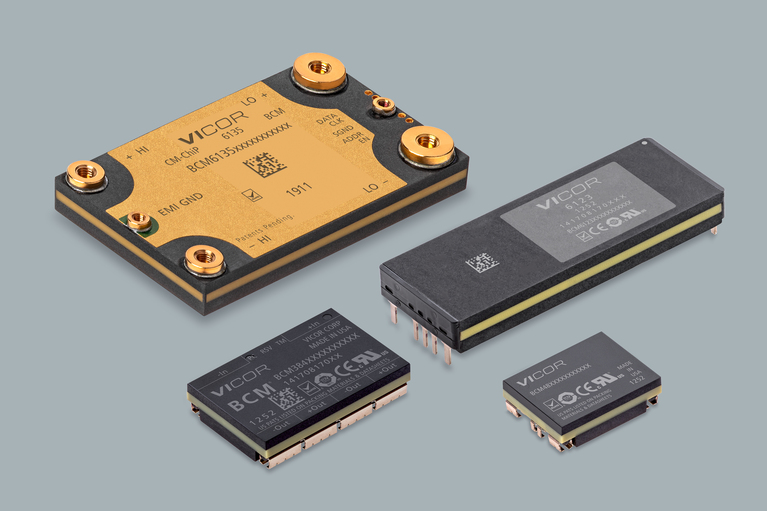
A half-chip BCM Bus Converter (K=1/4) measuring just 22 x 16.5 x 6.7mm was used to provide the isolated 12V rail. A ZVS Buck regulator provided the regulated 5V rail to the processor and a ZVS Buck-Boost regulator provided the precisely regulated 12V rail to drive the RF power amplifier stage. Both regulators measure a compact 14 x 10 x 2.6mm. To analyze this power chain, go to Vicor Whiteboard online tool.
非絶縁 レギュレータ
入力電圧: 12V (8 – 18V), 24V (8 – 42V), 48V (30 – 60V)
出力電圧: 2.2-16V
出力電流: 最大22A
ピーク効率: 98%
10.0 x 10.0 x 2.56mm 他
絶縁 電圧変換比固定
入力電圧: 36 – 800V
出力電圧: 2.4 – 55.0V
出力電流: 最大150A
ピーク効率: 98%
22.0 x 16.5 x 6.7mm 他
Powering AI processors – 48V vertical power delivery changes the game
AI models demand huge current, driving legacy multiphase designs past 50 phases—causing space, thermal, and control limits Vicor addresses
Innovative 48V AI power architecture delivers both high current density and high current gain
Vicor 48V Factorized Power Architecture slashes thermal losses and delivers high current density to meet the extreme power demands of AI processors
48V Factorized Power Architecture™ slashes thermal losses and outperforms multiphase approach when powering AI
AI hardware faces severe power and cooling limits. Engineers debate 48V vs. 6V intermediate buses alongside new vertical power delivery (VPD) structures
Betterfrost: Putting on the heat
Betterfrost uses a 48V module for pulsed, conductive glass heating, clearing ice in under 80 seconds while cutting start-up defrost energy by 95%