
Using the Non-Isolated DCM™ in High-Power Arrays


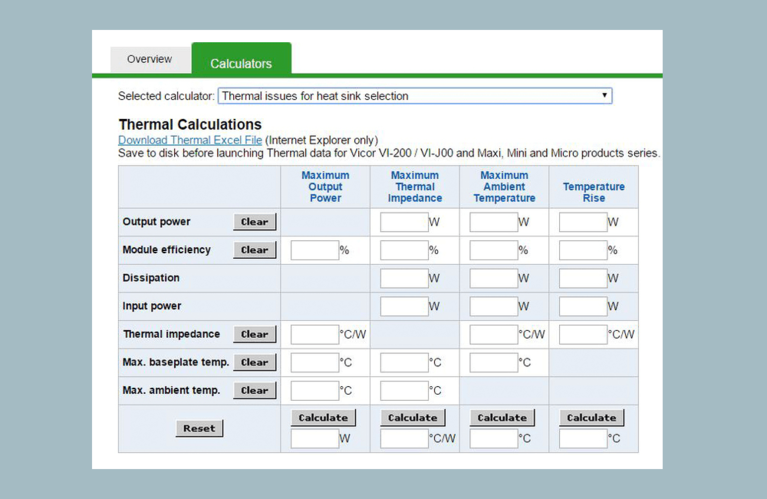
Thermal calculations required when selecting heat sinking are relatively straightforward but can be time-consuming, particularly if you want to investigate the impact of changes to certain parameters. To help speed up the process of determining what heat sink is required for your design, the Vicor tool suite includes a calculator that lets you quickly and easily evaluate thermal issues for heat sink selection.
The tool can make four separate calculations:
Originally designed for use with Vicor modules, the tool can also be applied to thermal calculations for our other products. For more in-depth calculations, there is an option to download an Excel spreadsheet.
Ensuring adequate heat sinking is critical for reliable power system operation. Try the thermal calculation for heat sink selection, and see how it could speed up your development process.
Using the Non-Isolated DCM™ in High-Power Arrays
Current gain and current density essential to power AI today: Patrizio Vinciarelli interview
Patrizio Vinciarelli, CEO of Vicor shares insights on powering AI today and its extraordinary current demands and the need to easily scale
Revolt is tackling the film industry’s dirtiest production secret - CO2 emissions
ReVolt Fuel tackles the film industry emitting 700k tons of CO2 per year to deliver clean on-set electricity with help of Vicor power modules
Powering AI Processors using a 48V Factorized Power Architecture™
Using a 48V Factorized Power Architecture™ to overcome traditional multiphase limitations and drastically cut I²R thermal losses for high-demand loads