Powering AI processors – 48V vertical power delivery changes the game
AI models demand huge current, driving legacy multiphase designs past 50 phases—causing space, thermal, and control limits Vicor addresses


Recent improvements in sensors and software allow autonomous robots to identify and avoid human workers or other obstacles and to travel to their destination by the shortest route, rather than being limited to defined robot pathways. These nimble robots are required to carry parts or finished goods 24/7 as a key contributor to the SMART factory, providing faster delivery and lower costs. This manufacturer of robots was looking to maximize time between recharges without impacting other performance factors. The key goals were:
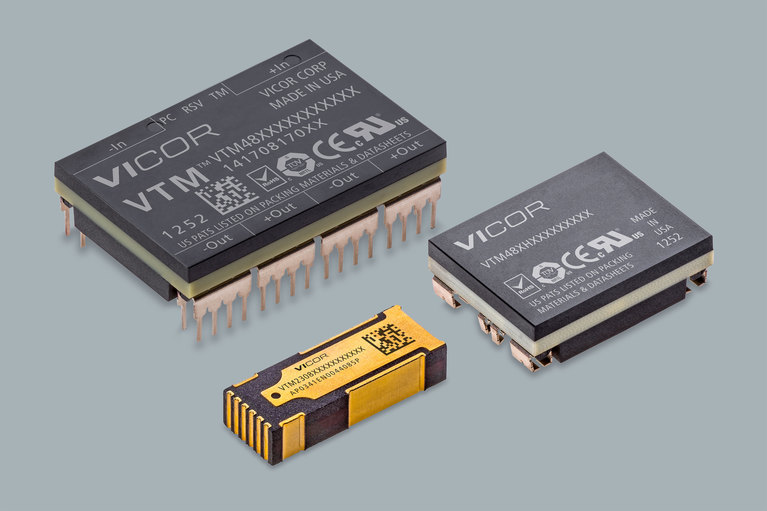
The power for the robot came from a 48V battery stack, which powered the motor drive directly. The power supply was required to convert the battery input to three rails of 6V and one of 12V to power the sensors, navigation interfaces and CPU. The solution was based on four arrays of Vicor PRM and VTM converters, one array for each output. Key benefits were:

Small footprint, low profile (6.7mm)

Lowest losses achieved by high efficiency conversion (>92.7%)

Lightweight
Four PRM/VTM converter combinations provided the isolation and regulation for each output. The ability to parallel converters accommodated the output powers required (6V at 60W and 12V at 600W). Output rail power sequencing was easily achieved though configuration of the PRMs. To analyze this power chain go to the Vicor Whiteboard online tool.

非絶縁 レギュレータ
入力電圧: 48V (36 – 75V)
出力電圧: 48V (5 – 55V)
出力電流: 最大600W
ピーク効率: 98%
22.8 x 13.8 x 7.41mm 他
絶縁 電圧変換比固定
入力電圧: 0 – 60V
出力電圧: 0 – 55V
出力電流: 最大130A
ピーク効率: 97%
22.83 x 8.52 x 4.9mm 他
Powering AI processors – 48V vertical power delivery changes the game
AI models demand huge current, driving legacy multiphase designs past 50 phases—causing space, thermal, and control limits Vicor addresses
Innovative 48V AI power architecture delivers both high current density and high current gain
Vicor 48V Factorized Power Architecture slashes thermal losses and delivers high current density to meet the extreme power demands of AI processors
48V Factorized Power Architecture™ slashes thermal losses and outperforms multiphase approach when powering AI
AI hardware faces severe power and cooling limits. Engineers debate 48V vs. 6V intermediate buses alongside new vertical power delivery (VPD) structures
Betterfrost: Putting on the heat
Betterfrost uses a 48V module for pulsed, conductive glass heating, clearing ice in under 80 seconds while cutting start-up defrost energy by 95%