
Input filter design and test strategy for dual unsynchronized Sine Amplitude Converters (SAC™) in space power systems
This paper presents a complete design methodology for input filters in redundant power-conversion systems


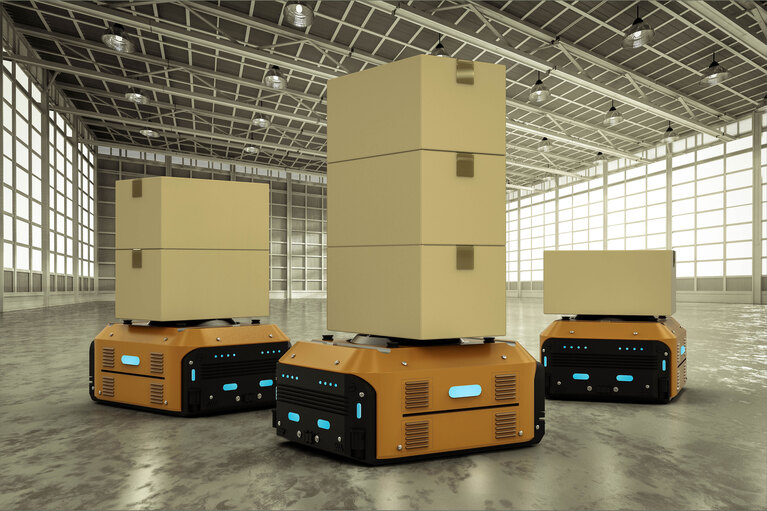
Recent improvements in sensors and software allow autonomous robots to identify and avoid human workers or other obstacles and to travel to their destination by the shortest route, rather than being limited to defined robot pathways. These nimble robots are required to carry parts or finished goods 24/7 as a key contributor to the SMART factory, providing faster delivery and lower costs. This manufacturer of robots was looking to maximize time between recharges without impacting other performance factors. The key goals were:
The power for the robot came from a 48V battery stack, which powered the motor drive directly. The power supply was required to convert the battery input to three rails of 6V and one of 12V to power the sensors, navigation interfaces and CPU. The solution was based on four arrays of Vicor PRM and VTM converters, one array for each output. Key benefits were:

Small footprint, low profile (6.7mm)

Lowest losses achieved by high efficiency conversion (>92.7%)

Lightweight
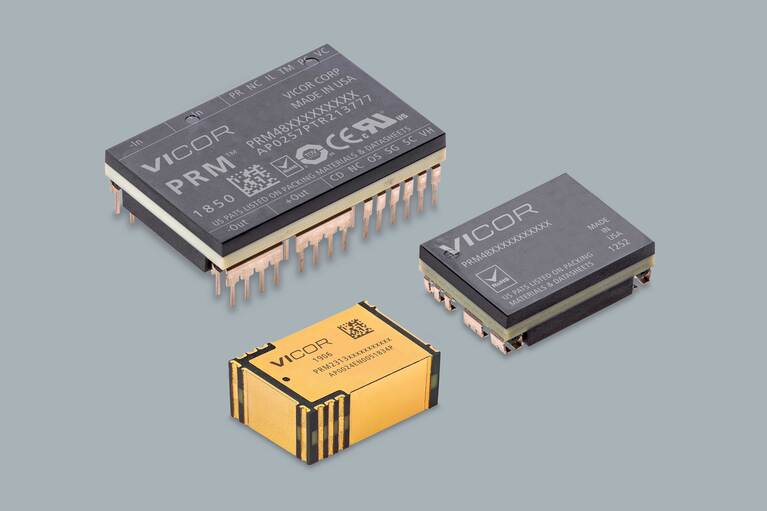
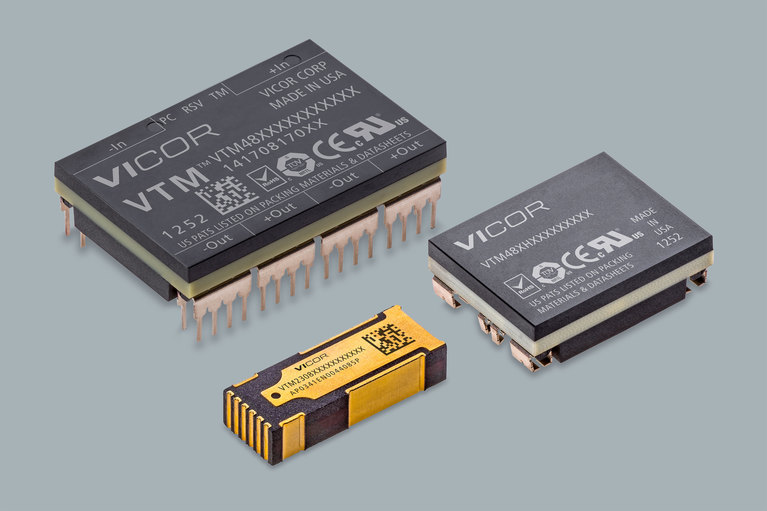
Four PRM/VTM converter combinations provided the isolation and regulation for each output. The ability to parallel converters accommodated the output powers required (6V at 60W and 12V at 600W). Output rail power sequencing was easily achieved though configuration of the PRMs. To analyze this power chain go to the Vicor Whiteboard online tool.

Non-isolated regulated
Input: 48V (36 – 75V)
Output: 48V (5 – 55V)
Power: Up to 600W
Peak efficiency: 98%
As small as 22.8 x 13.8 x 7.41mm
Isolated fixed-ratio
Input: 0 – 60V
Output: 0 – 55V
Current: Up to 130A
Peak efficiency: 97%
As small as 22.83 x 8.52 x 4.9mm
Input filter design and test strategy for dual unsynchronized Sine Amplitude Converters (SAC™) in space power systems
This paper presents a complete design methodology for input filters in redundant power-conversion systems
Innovative reliable power solutions for critical applications
A collection of technical resources aimed at educating users on the benefits of using modular power in aerospace and defense applications
Powering AI processors – 48V vertical power delivery changes the game
AI models demand huge current, driving legacy multiphase designs past 50 phases—causing space, thermal, and control limits Vicor addresses
Innovative 48V AI power architecture delivers both high current density and high current gain
Vicor 48V Factorized Power Architecture slashes thermal losses and delivers high current density to meet the extreme power demands of AI processors