

Input filter design and test strategy for dual unsynchronized Sine Amplitude Converters (SAC™) in space power systems
This paper presents a complete design methodology for input filters in redundant power-conversion systems


Case study: Tethered Underwater ROV

Allowing an underwater ROV to perform remote inspection activities at greater depths required the tether from the ship-based power source be extended. Distributing the original design’s low voltage over the longer tether was not practical due to voltage drops. Moving to a high-voltage 700V low-loss tether, however, required conversion to a lower SELV voltage onboard the ROV. This typically requires a custom converter that takes up space and adds weight, not feasible in an ROV that needs to be able to carry increased payloads. The key goals were:
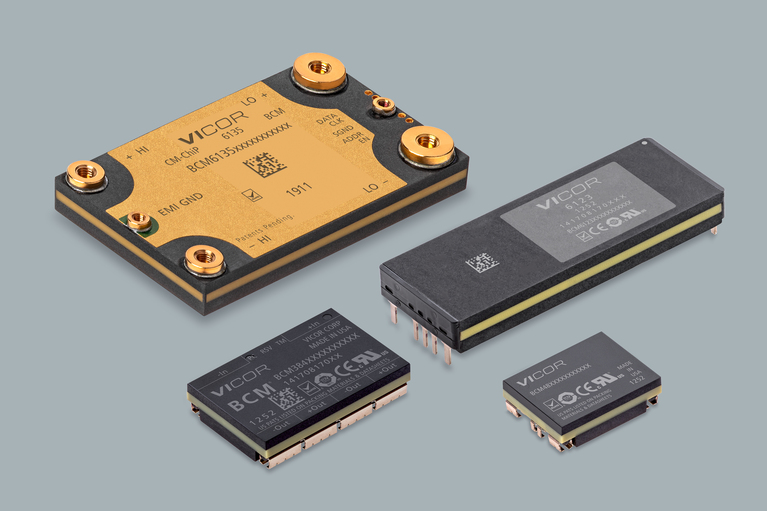
The extremely small, low weight BCM® Bus Converter, acting as a DC-DC transformer, converted the high voltage from the tether down to the 48V distribution architecture on board the ROV. It provided a simple, easy to implement, off-the-shelf solution.

High-voltage tether reduced the supply current, and thus losses for a given cross-section of copper conductor, allowing for a thinner, longer tether

Reduced footprint of 1.5kW solution to just 41cm2

Low noise conversion topology prevented interference with communications over the tether

Isolated fixed-ratio
Input: 36 – 800V
Output: 2.4 – 55.0V
Current: Up to 150A
Peak efficiency: 98%
As small as 22.0 x 16.5 x 6.7mm
Non-isolated regulated
Inputs: 12V (8 – 18V), 24V (8 – 42V), 48V (30 – 60V)
Output: 2.2 – 16V
Current: Up to 22A
Peak efficiency: 98%
As small as 10.0 x 10.0 x 2.56mm
Input filter design and test strategy for dual unsynchronized Sine Amplitude Converters (SAC™) in space power systems
This paper presents a complete design methodology for input filters in redundant power-conversion systems
Innovative reliable power solutions for critical applications
A collection of technical resources aimed at educating users on the benefits of using modular power in aerospace and defense applications
Powering AI processors – 48V vertical power delivery changes the game
AI models demand huge current, driving legacy multiphase designs past 50 phases—causing space, thermal, and control limits Vicor addresses
Innovative 48V AI power architecture delivers both high current density and high current gain
Vicor 48V Factorized Power Architecture slashes thermal losses and delivers high current density to meet the extreme power demands of AI processors