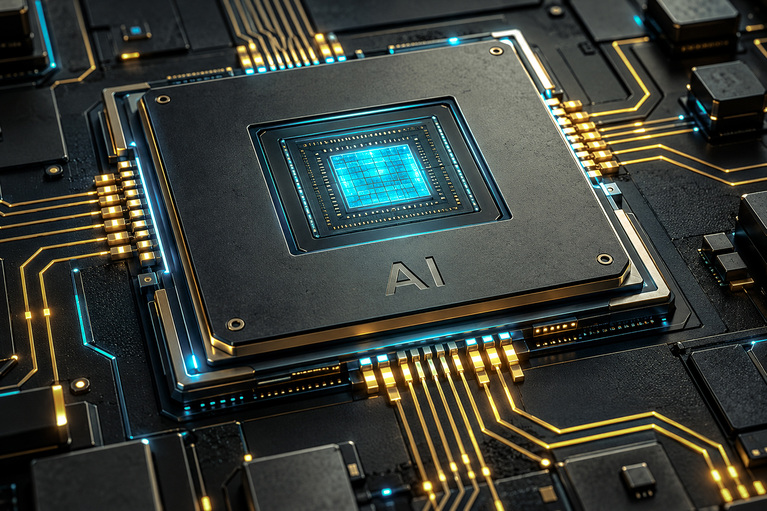
Powering AI processors – 48V vertical power delivery changes the game
AI models demand huge current, driving legacy multiphase designs past 50 phases—causing space, thermal, and control limits Vicor addresses


Compact

Lightweight

Wide-range regulation
Doosan Mobility Innovation (DMI), a leader in hydrogen fuel cell technology has developed the world’s first commercialized hydrogen fuel cell power pack that delivers breakthrough energy density, about 4 – 5 times that of a battery, enabling drones to fly for up to 2 hours. With the extended range that the hydrogen fuel cell power pack provides, DMI is delivering global humanitarian relief. Their drones have transported masks and emergency supplies between the US Virgin Islands and delivered medical AEDs to the top of Mt. Hallasan, South Korea’s tallest mountain on Jeju Island.

High-power density

Reliable
Wide voltage range
DMI's DP30 power pack has two main power delivery networks (PDNs) that supply power to the drone’s rotors and the intelligent controller for the two stacks. Because of the wide-range and variable output voltage of the DP30 power pack, from 40 – 74V, the powertrains were designed to ensure a tightly regulated 48V, 12A output to the rotor motors of the drone, plus a 12V, 8A output to the stack controller board and fans.
To achieve high-efficiency and high-energy density in the PDN, DMI selected Vicor PRM™ buck-boost regulators and a Vicor ZVS buck regulator. The PRMs support the up to 74V open-circuit voltage (OCV) of the hydrogen fuel cell stack and perform a stable voltage regulation to 48V. In the drone’s rotor-side PDN, two PRM buck-boost regulators (PRM48AF480T400A00) are configured in parallel to supply the 12A required by the rotors. The PDN for the digital controller board in the stack uses a lower-power PRM (PRM48AH480T200A00) followed by a 48V – 12V ZVS buck regulator (PI3546-00-LGIZ).

Non-isolated regulated
Input: 48V (36 – 75V)
Output: 48V (5 – 55V)
Power: Up to 600W
Peak efficiency: 98%
As small as 22.8 x 13.8 x 7.41mm
Non-isolated regulated
Inputs: 12V (8 – 18V), 24V (8 – 42V), 48V (30 – 60V)
Output: 2.2 – 16V
Current: Up to 22A
Peak efficiency: 98%
As small as 10.0 x 10.0 x 2.56mm
Powering AI processors – 48V vertical power delivery changes the game
AI models demand huge current, driving legacy multiphase designs past 50 phases—causing space, thermal, and control limits Vicor addresses
Innovative 48V AI power architecture delivers both high current density and high current gain
Vicor 48V Factorized Power Architecture slashes thermal losses and delivers high current density to meet the extreme power demands of AI processors
48V Factorized Power Architecture™ slashes thermal losses and outperforms multiphase approach when powering AI
AI hardware faces severe power and cooling limits. Engineers debate 48V vs. 6V intermediate buses alongside new vertical power delivery (VPD) structures
Betterfrost: Putting on the heat
Betterfrost uses a 48V module for pulsed, conductive glass heating, clearing ice in under 80 seconds while cutting start-up defrost energy by 95%